Highlights
Bhaktapur Multiple Campus Leads International Conference on Mathematical Biology in Nepal
Pokhara, June 14, 2025
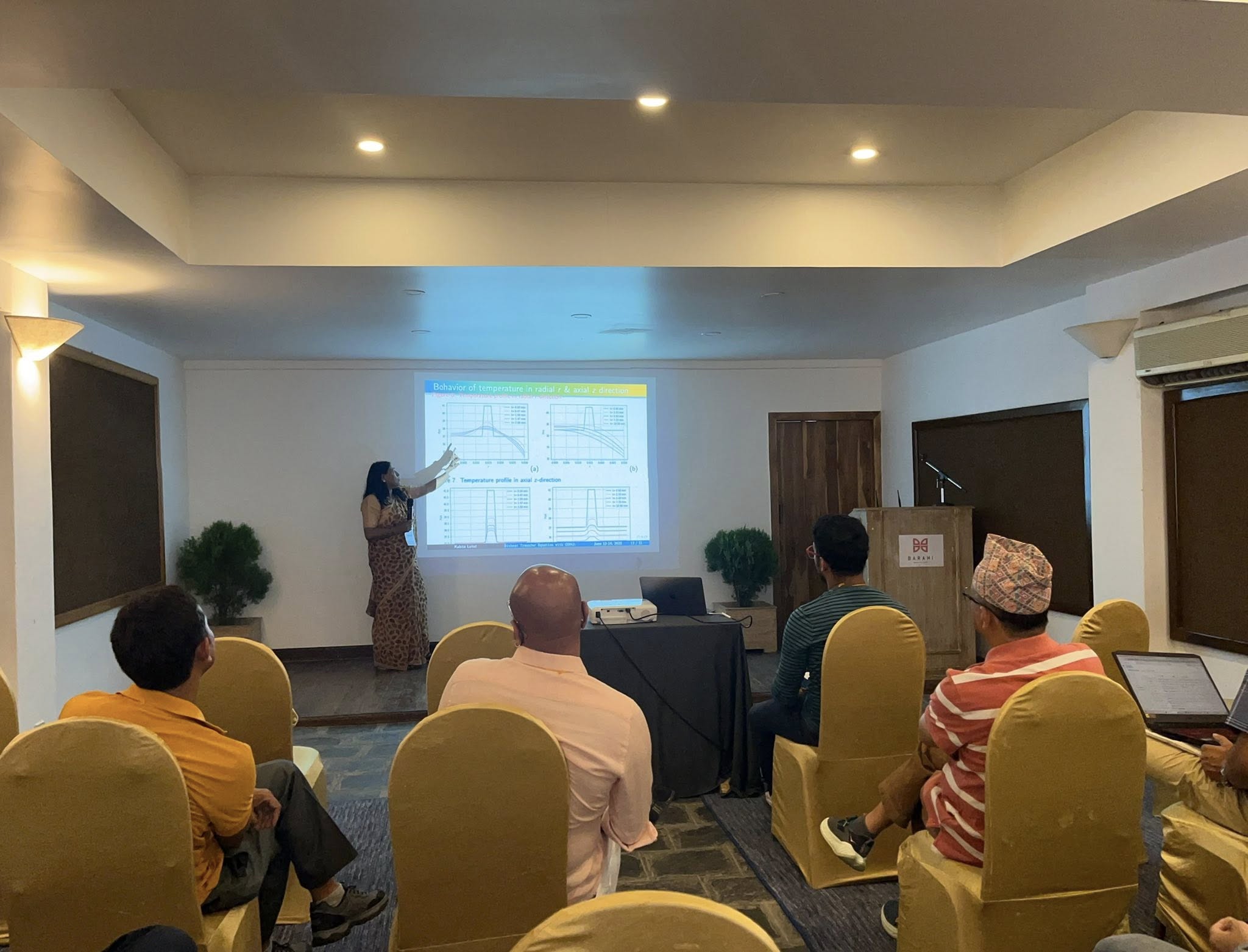
Bhaktapur Multiple Campus (BMC), Tribhuvan University, proudly served as the lead organizer of the International Conference on Mathematical Biology (ICMB-2025) held from June 12–14, 2025, at Hotel Barahi, Pokhara. The event was organized in collaboration with the Central Department of Mathematics, Tribhuvan University and the Mathematical Biology Research Centre–Nepal (MBRC-Nepal), with generous support from the Nepal Academy of Science and Technology (NAST) and the University Grants Commission (UGC).
Themed “Quantitative Modeling and Computation in Life Sciences and Medicine,” the conference brought together 57 participants from 14 countries including the USA, UK, Canada, Germany, Israel, South Korea, Japan, India, and Nepal. The formal inauguration was led by Prof. Bed Raj K.C., Vice-Chancellor of Pokhara University, and attended by leading academic and institutional dignitaries.
Objectives of the Conference
The ICMB-2025 was organized with the following key objectives:
Plenary Talks: Bridging Mathematical Theory with Real-World Medical Challenges
The conference featured three eminent plenary speakers, each delivering high-impact presentations that exemplified the role of mathematics in solving critical biomedical issues:
Scholarly Contributions: Global Themes with Local Relevance
Beyond the plenary sessions, the conference hosted dozens of invited and contributed speakers. Notable among the Nepal-based scholars were:
International speakers from institutions like the Technion-Israel Institute of Technology, Texas Biomedical Research Institute, and National Institute of Technology, India shared pioneering research on viral modeling, ecological systems, infectious disease control, and data-driven medical diagnostics.
Impact and Future Outlook
The ICMB-2025 conference served as a catalytic platform for promoting interdisciplinary collaboration, advancing local scientific capacity, and positioning Nepal as an emerging hub for mathematical biology. It also strengthened links between academic institutions in Nepal and global research communities, opening avenues for future funding, training, and joint publications.
Organized with vision and dedication by Bhaktapur Multiple Campus, this landmark conference exemplified how Nepalese institutions can drive global scientific dialogue while addressing national and regional health priorities through the lens of mathematics.